Skip to content

From card to keepers before the coffee’s cold.

Copy off the card, cull from the keyboard, caption and send — in one window, on the folders already on your drive.

macOS and Windows
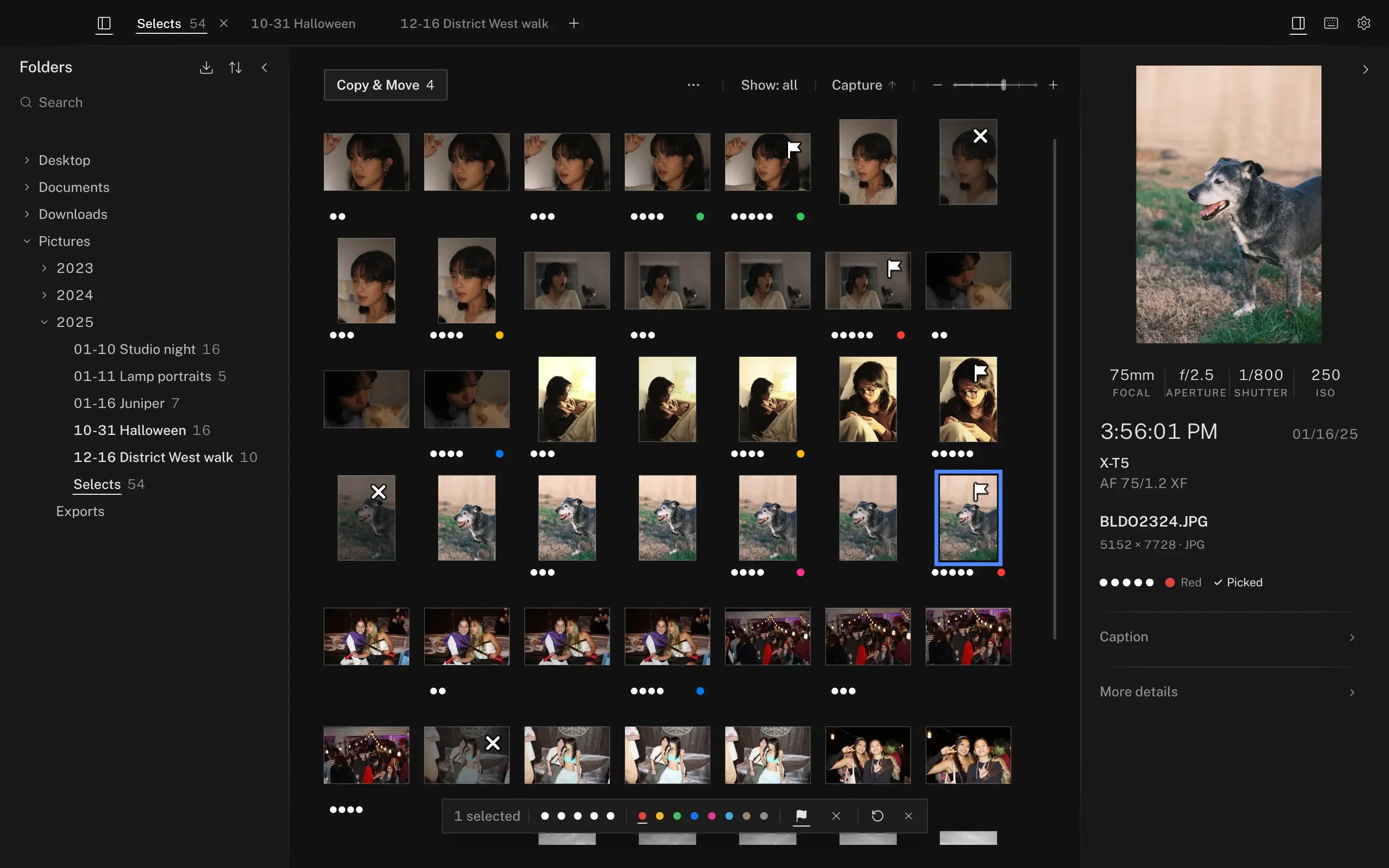
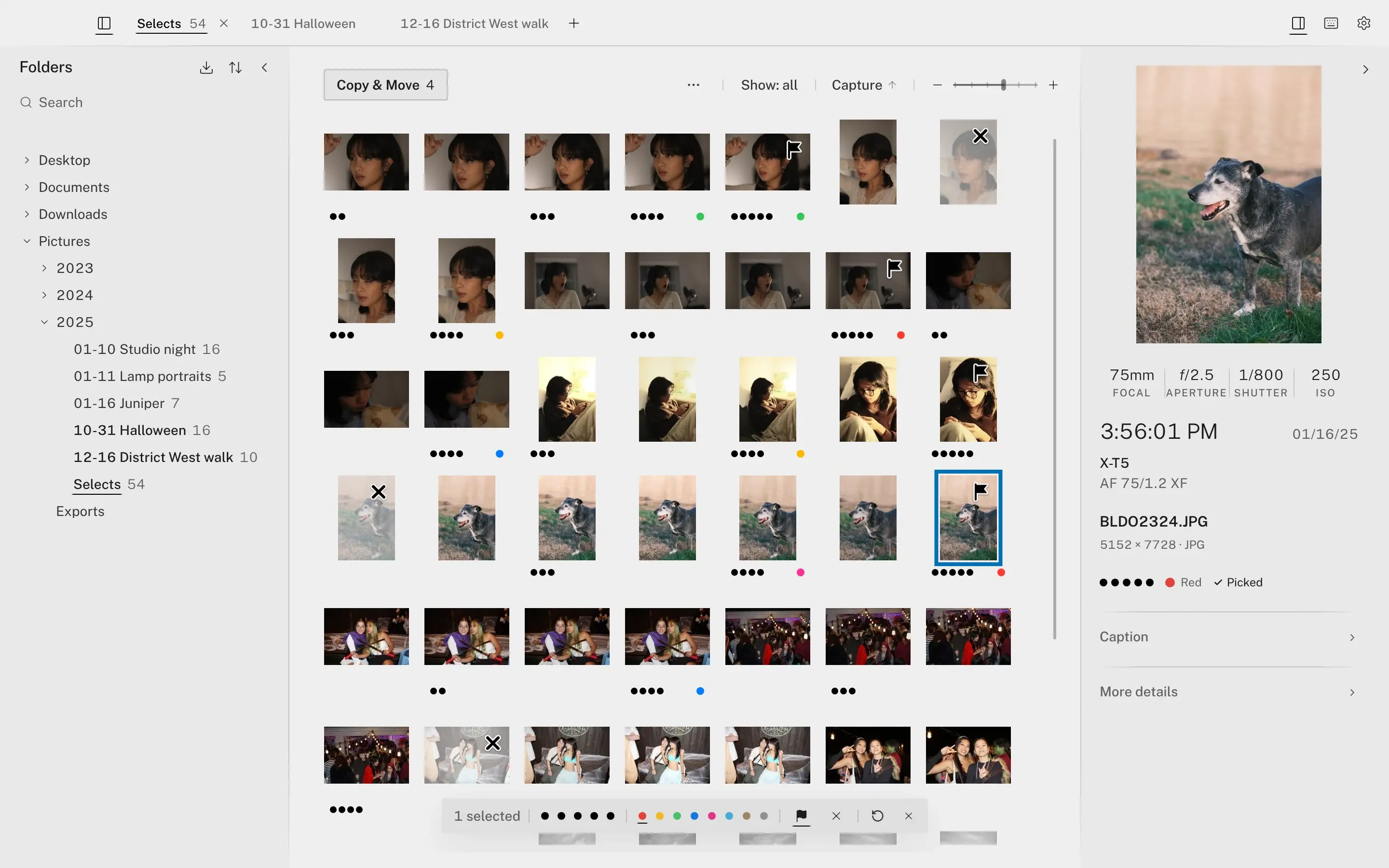
Lamplit's grid view in the dark theme. Tabs for three folders run along the top; the folder tree is on the left; the centre is a contact sheet of portraits, a dog and a Halloween party, with rating dots and colour-label dots under the tiles, a pick flag on some and a reject cross on others. One tile is selected, and the panel on the right shows its picture, focal length, aperture, shutter speed and ISO, the capture time, camera and lens, filename and size, its five-star rating, red label and pick.Lamplit's grid view in the dark theme. Tabs for three folders run along the top; the folder tree is on the left; the centre is a contact sheet of portraits, a dog and a Halloween party, with rating dots and colour-label dots under the tiles, a pick flag on some and a reject cross on others. One tile is selected, and the panel on the right shows its picture, focal length, aperture, shutter speed and ISO, the capture time, camera and lens, filename and size, its five-star rating, red label and pick.
The grid, mid-cull

Keyboard first

Culling is the slowest part of the job.

You already know which frames are keepers. The work is getting through them — so every decision is one key, and the next frame is already there.

  • P/TToggle pick / flag
  • X/DeleteToggle reject
  • 0–5Set star rating
  • ←/→Move through the take
  • EnterOpen the focused photo in the loupe
  • Space/EscBack to the grid

These are the defaults. Most can be reassigned in Settings — the arrows, Home, End, Enter, Esc and the help key stay fixed. Nothing in Lamplit rates a frame for you: auto advance moves to the next one the moment you decide, and undo covers the whole batch.
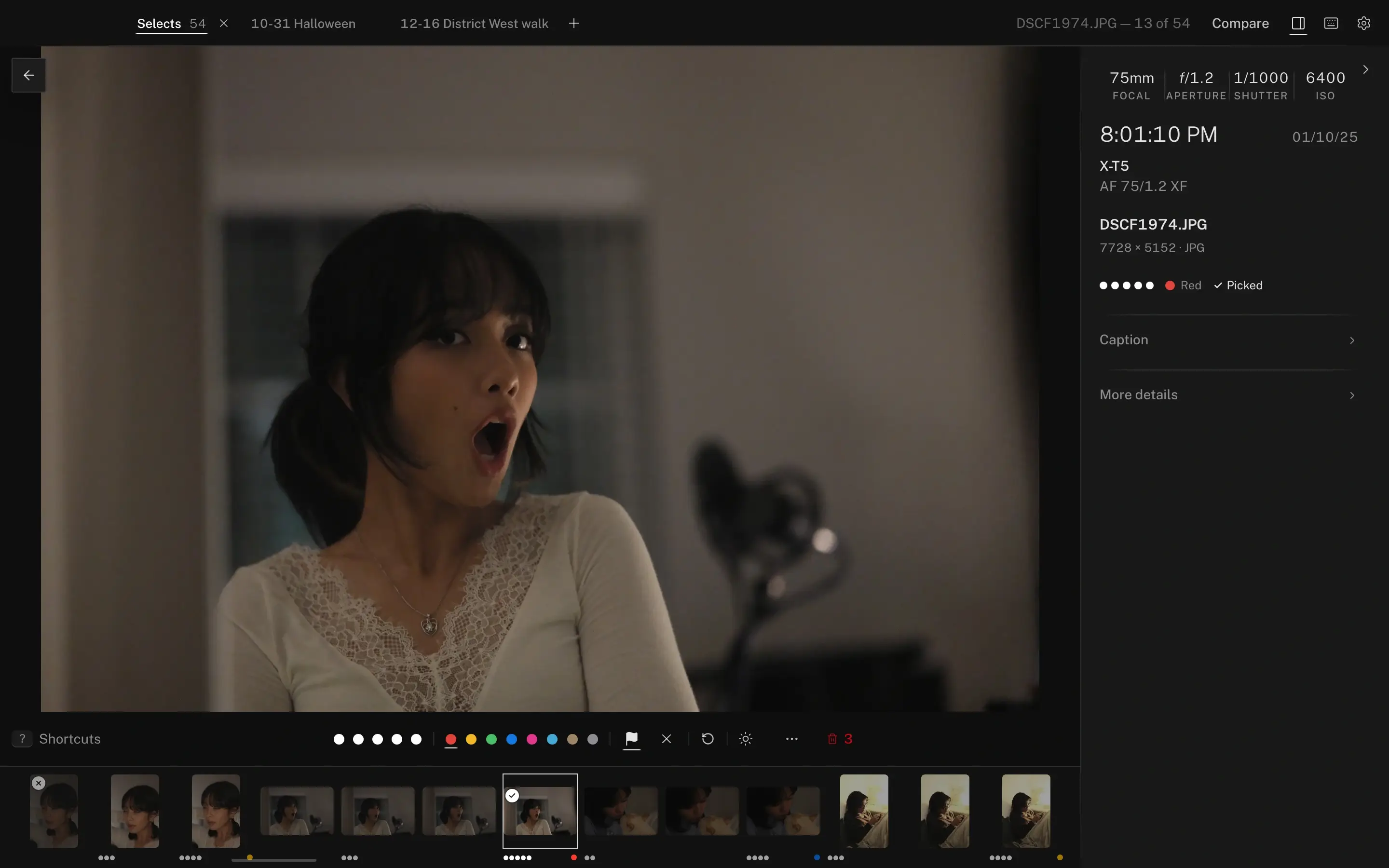
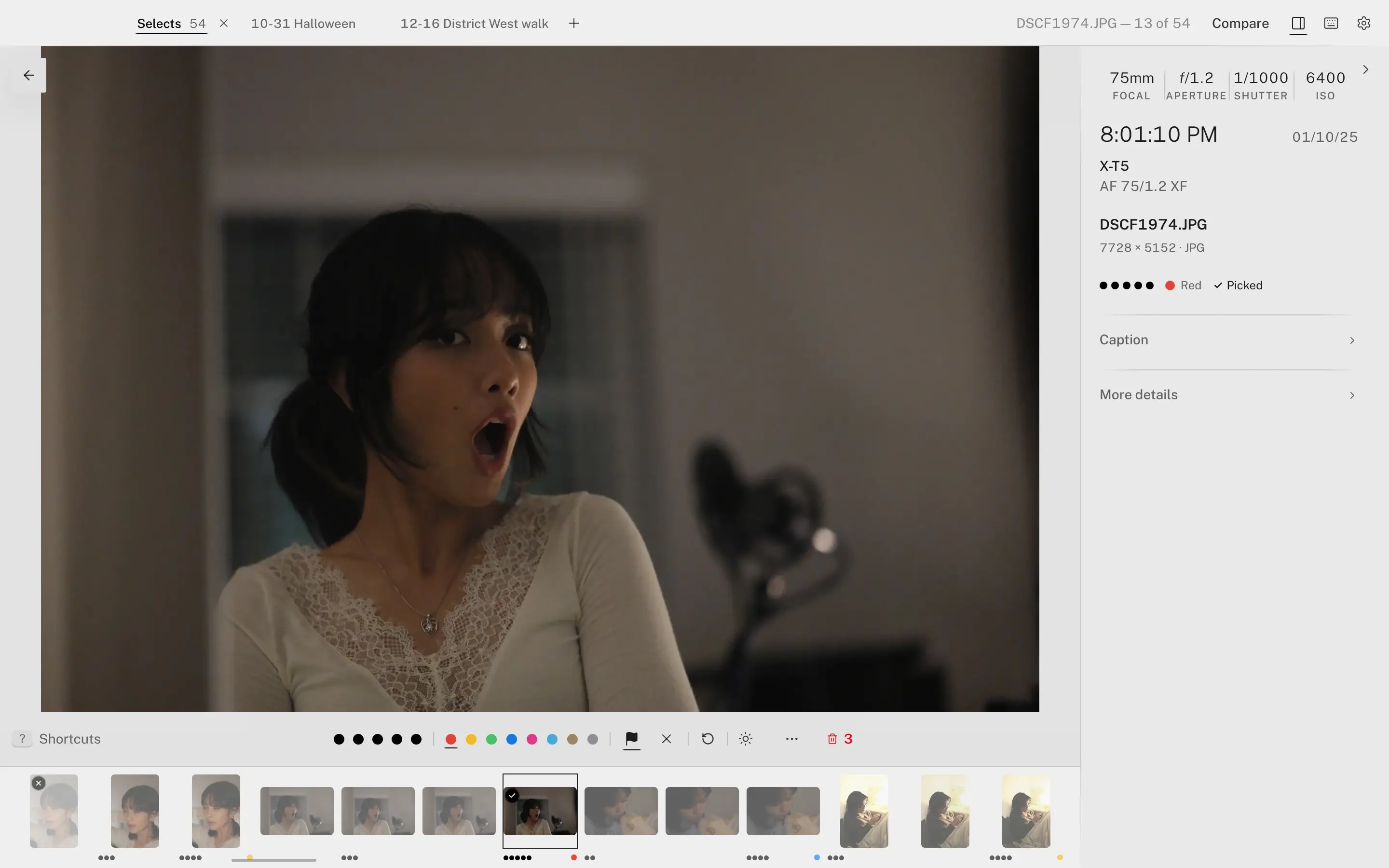
Lamplit's single-photo view. A portrait fills the frame; beneath it a plain row of controls — five rating dots, eight colour-label dots, pick, reject, reset, exposure — and a filmstrip of the take, the current frame outlined. The panel on the right shows focal length, aperture, shutter and ISO in four cells, the capture time, camera and lens, the filename, the rating, a red label and Picked.Lamplit's single-photo view. A portrait fills the frame; beneath it a plain row of controls — five rating dots, eight colour-label dots, pick, reject, reset, exposure — and a filmstrip of the take, the current frame outlined. The panel on the right shows focal length, aperture, shutter and ISO in four cells, the capture time, camera and lens, the filename, the rating, a red label and Picked.
Single-photo view: the tag bar, the filmstrip, the shot in four cells

Format support

Will it open your files?

We ran Lamplit’s own preview code over 2,792 real raw files and checked every picture against an independent render. 97.8% show the right picture. Every file that doesn’t is named, with the reason.

2,792
Raw files
1,086
Models
246/263
Popular cameras
  • CanonCR2 CR3 CRW DNG203 models · 518 files
  • NikonDNG NEF NRW99 models · 330 files
  • SonyARQ ARW SR2 SRF111 models · 346 files
  • FujifilmDNG RAF88 models · 308 files
  • PanasonicDNG RAW RW2121 models · 331 files
  • OM System / OlympusORF ORI72 models · 180 files
  • LeicaDNG RAW RWL47 models · 109 files
  • Pentax / RicohDNG PEF RAW50 models · 146 files
  • Hasselblad3FR ARW DNG FFF19 models · 33 files
  • Phase OneIIQ17 models · 34 files

Ingest from card

Copy off the card, and know where it all went.

Your photos go straight from the card to your drive, and to a backup if you set one — into dated folders, renamed with your template if you like, RAW and JPEG pairs and their sidecars together.
Nothing half-written
Each file is written under a temporary name and renamed into place, so a half-copied file never appears.
Nothing overwritten
A name already taken at the destination is never replaced: the copy gets a new name, or is skipped if it is the same photo, and the summary says which.
Checked, if you ask
Tick Verify every copy and each file is read back and checked against a SHA-256 hash before it counts. Off by default, as in Photo Mechanic.
A Move always checks
Every copy is checked before an original is retired, and an original that leaves a drive goes to the Trash — never a permanent delete.
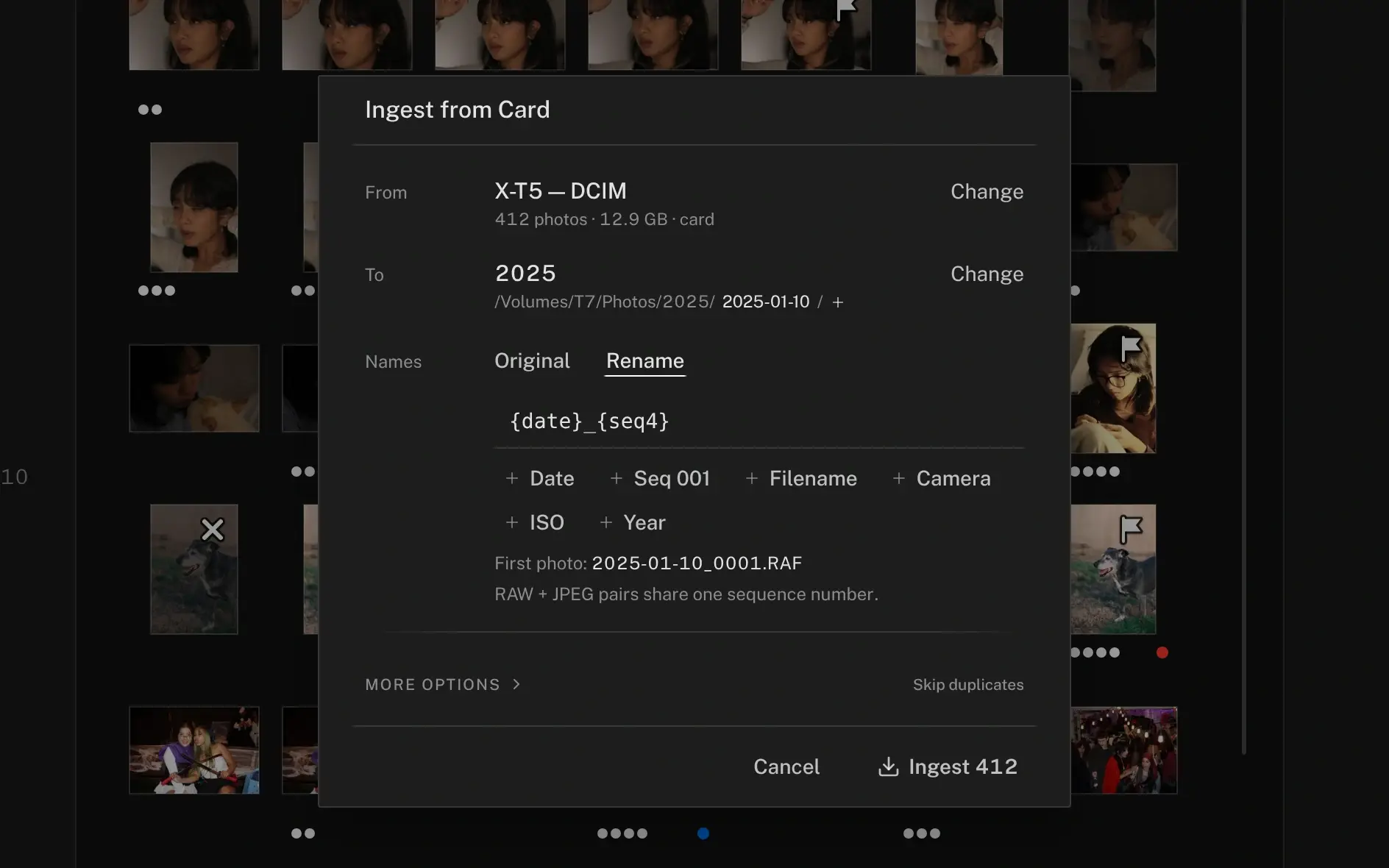
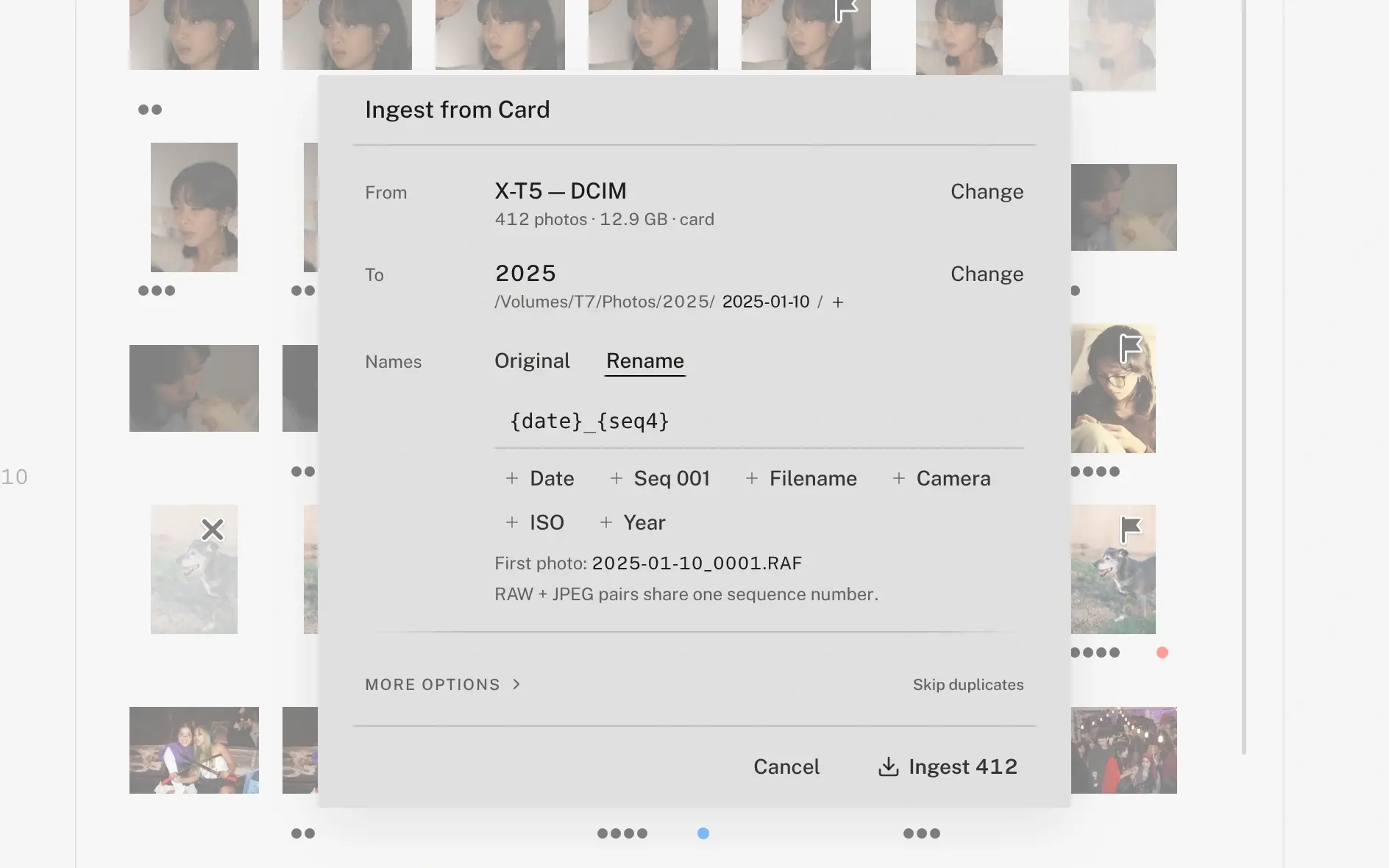
The Ingest from Card sheet over the grid. From: the camera's card, with its photo count and size. To: a dated folder on an external drive. Names: Original or Rename, with a template built from Date, Sequence, Filename, Camera, ISO and Year tokens, and the first photo's resulting name shown beneath. More options, Skip duplicates, and the Cancel and Ingest buttons.The Ingest from Card sheet over the grid. From: the camera's card, with its photo count and size. To: a dated folder on an external drive. Names: Original or Rename, with a template built from Date, Sequence, Filename, Camera, ISO and Year tokens, and the first photo's resulting name shown beneath. More options, Skip duplicates, and the Cancel and Ingest buttons.
Ingest from Card: source, destination, names, and the first file’s name before anything is copied

The whole loop

Ingest, cull, caption, send.

Every step in one window. AI cullers touch the first and hand you back for the rest.

01Cull

Every pick is yours

Arrow through the take. X rejects, a number rates, T picks. Put up to six frames side by side and move each on its own.

02Caption

Captions that stick

IPTC and XMP written together, patched in place — what Lightroom wrote stays written. Set your credit once; it fills blank fields and never overwrites one.

03Send

Out before you leave

Copy & Move into dated folders, export resized JPEGs under your own naming template, or send to the desk over FTPS or SFTP.

Plus crop and straighten, an exposure preview that never touches the file, capture-time sync, GPS and place names, batch rename and folder watching. The keyboard reference is one page, and it prints.
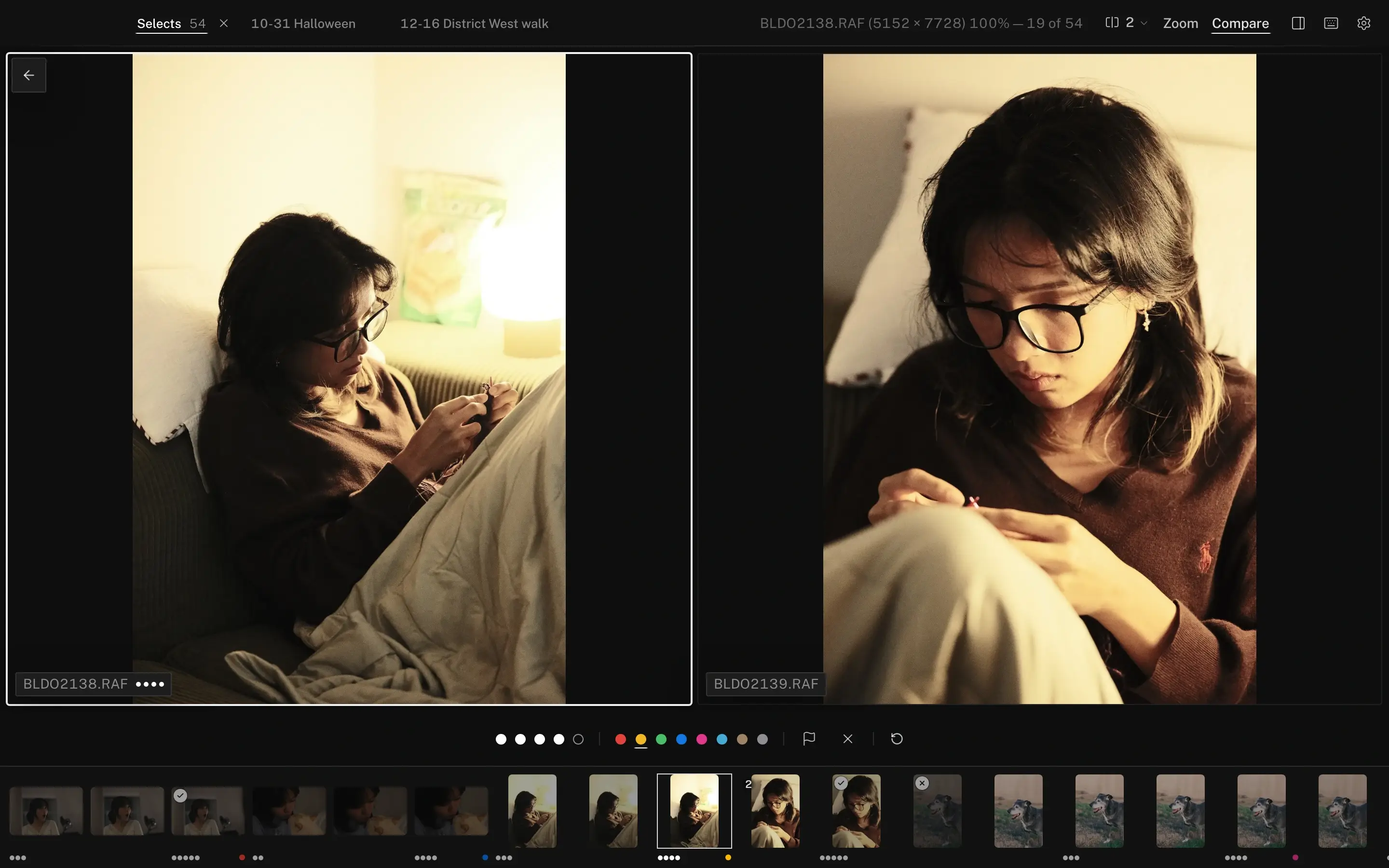
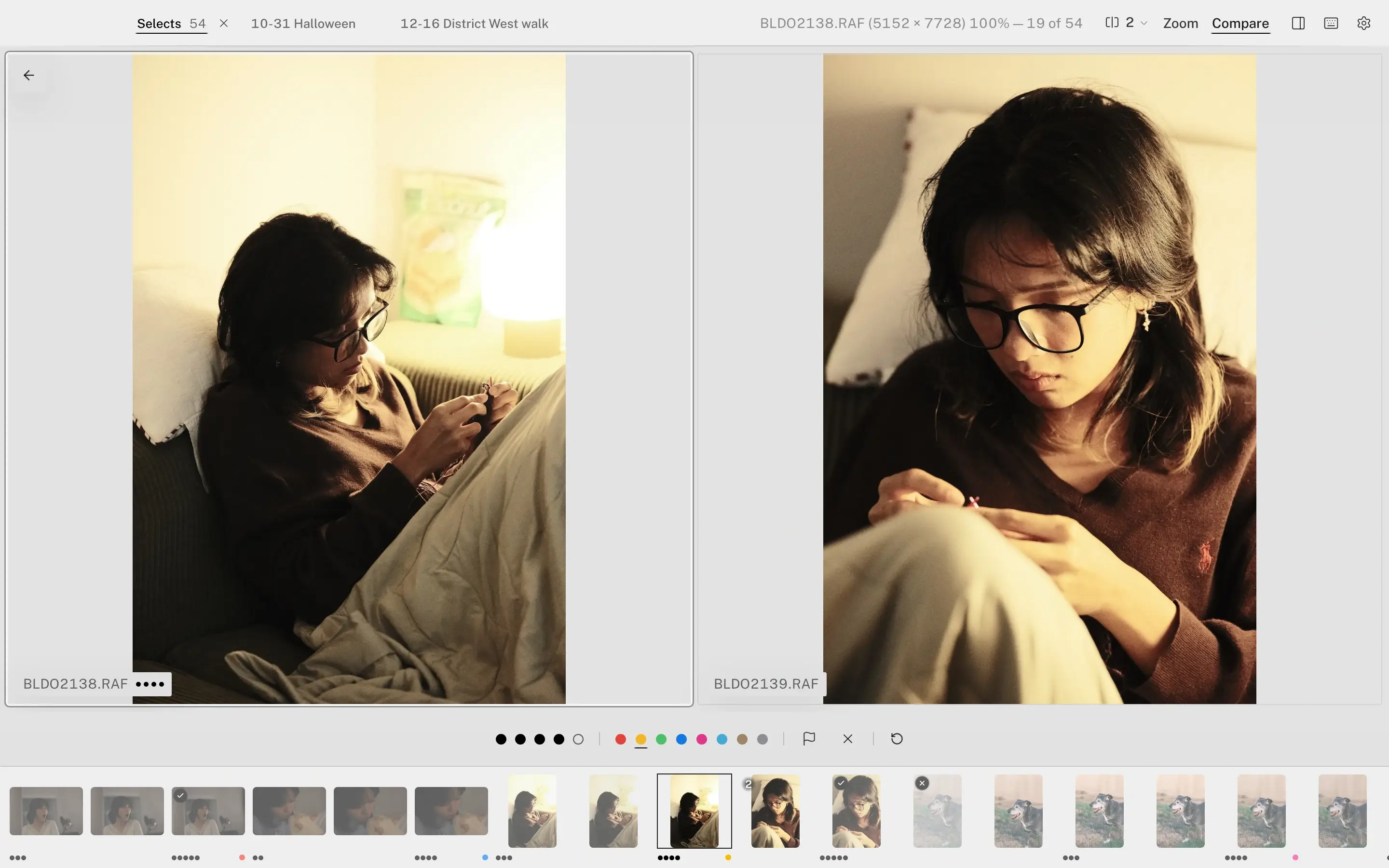
Compare view with two near-identical portraits side by side, the left pane active and outlined, each labelled with its RAF filename and rating dots, the tag bar beneath and the filmstrip along the bottom.Compare view with two near-identical portraits side by side, the left pane active and outlined, each labelled with its RAF filename and rating dots, the tag bar beneath and the filmstrip along the bottom.
Compare: two frames, each pane moving on its own
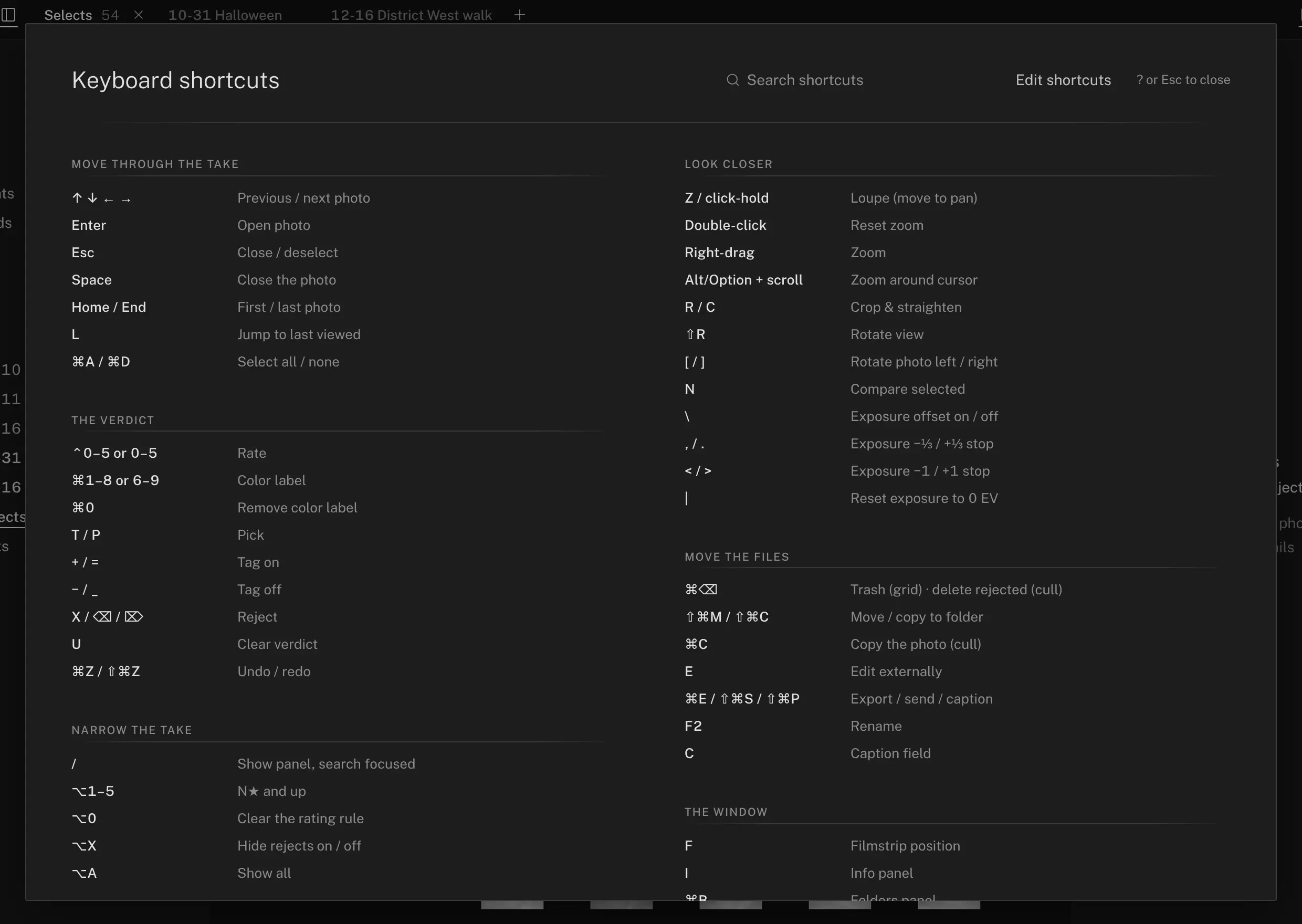
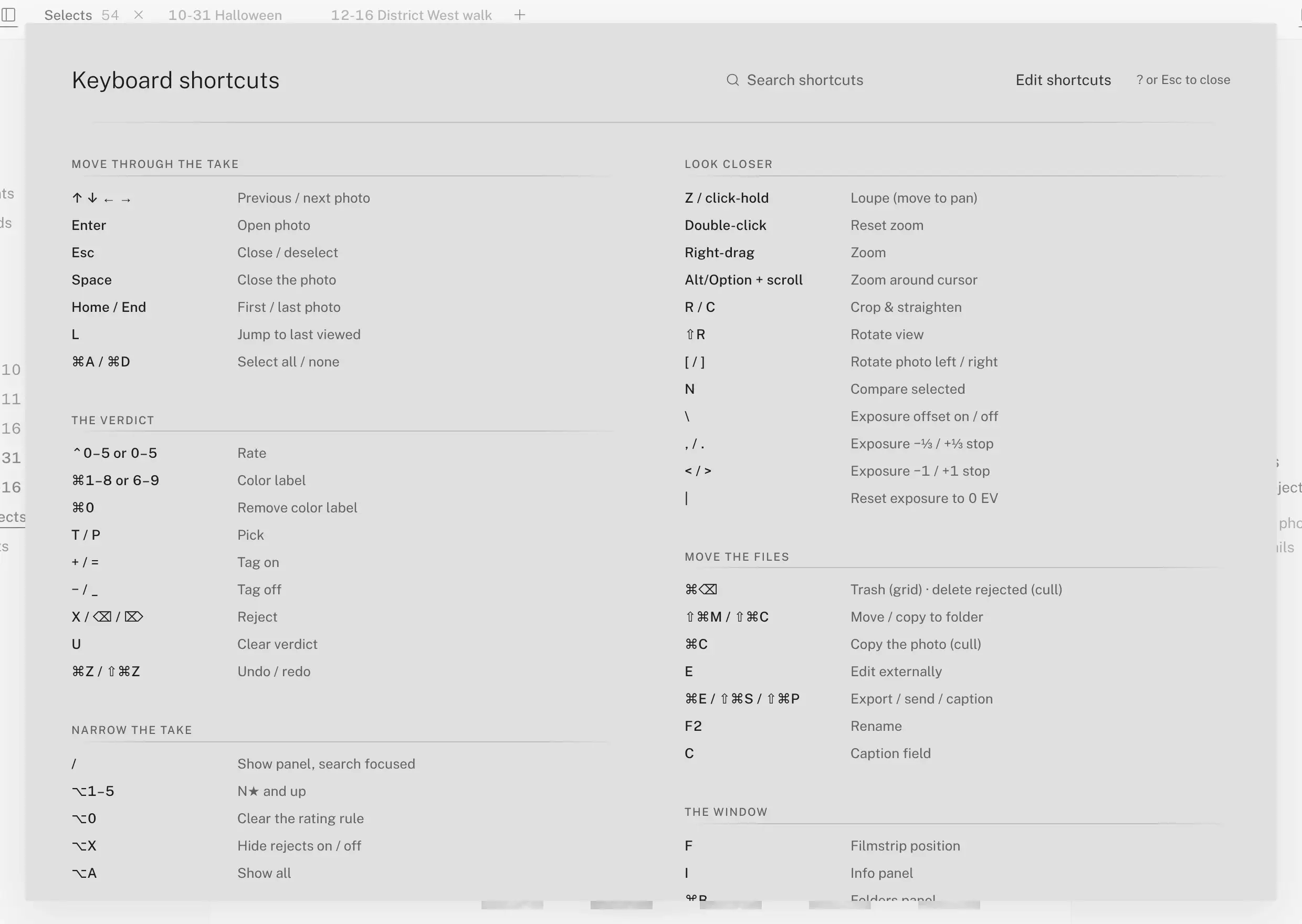
The full-window keyboard reference: sections for moving through the take, the verdict, narrowing the take, looking closer, moving the files and the window, each key in ink beside its action, with a search field and an Edit shortcuts control at the top.The full-window keyboard reference: sections for moving through the take, the verdict, narrowing the take, looking closer, moving the files and the window, each key in ink beside its action, with a search field and an Edit shortcuts control at the top.
The keyboard reference, searchable, with Edit shortcuts beside it

External drives

Built for the drives you work from.

Shoot drives, card readers and network shares are where the work lives. Lamplit treats them as normal, not as a problem.

Nothing to relink
There is no catalogue, so a drive is just a folder. Nothing to reconnect, nothing to repair.
Read once
Thumbnails are kept on your computer rather than on the drive, so opening the folder again does not go back to it.
Calm when one disconnects
Its tabs close instead of sitting open on errors, and its folders stay in the list, greyed out, until it is back.
Clear about what happened
Disconnected drive, or moved folder: it tells you which, because they need different fixes.

Plainly

What Lamplit isn’t.

No AI picks

Nothing ranks your frames or suggests a select.

No editing

Crop, straighten and an exposure preview — none of it written into your original.

No catalogue

It opens the folders already on your disk.

No Adobe tax

Not a plugin. Doesn’t need Creative Cloud.

Seven reasons to use something else, each naming the tool to use instead, are on who it isn’t for.

Who it’s for

Photographers with a deadline.

Weddings and events

Eight thousand frames from a Saturday, due Monday. Tabs and sessions survive a restart.

Sports and news

Built for the desk deadline, with the IPTC a wire service expects.

Portrait and studio

School days and league nights. Batch rename, capture-time sync across bodies, filters that find one kid.

Provenance

How it’s built, and what that costs you.

Two people: one writes the software, one shoots for a living in Seattle and has been the harshest user of every build. The longer version is on About.

Native, not a web app
Compiled, not a browser in a wrapper. The download is tens of megabytes, not hundreds.
Nothing leaves unless you say so
No account and no cloud. Usage pings and crash reports are off until you turn them on. Transmit passwords live in the system keychain.
Your raws are never rewritten
Ratings and captions for a raw go in an XMP sidecar beside it. In a JPEG they are patched into the file in place, as Photo Mechanic and Lightroom do.
The format list is a test, not a claim
Every figure on /formats comes from running the app’s own code over 2,792 real files. Nothing on it is claimed before a file has been through.

Get in before there’s a price.

Small waves, so every report gets a real answer. Everyone in the beta keeps $59 a year, permanently.

We’ll email you when Lamplit can be downloaded, and about your trial. Product news only if you tick the box and confirm. No list sharing, ever.

macOS 10.15 or newer — universal (Apple silicon and Intel) · Windows 10 or newer — x64 and ARM64